
Lion’s Mane, with a little help from light.
Activated Organic Lion’s Mane Powder. A familiar mushroom with a hidden nutritional gift, unlocked by light.


Lion’s Mane in the world
One mushroom. Centuries of curiosity.
Lion’s Mane is an edible mushroom found across temperate parts of North America, Europe and Asia. Its cascading white spines make it look unlike the familiar cap-and-stem mushrooms found in most kitchens.
History + food culture
Lion’s Mane has a long history as both food and a subject of traditional practice in East Asia. Today, cooks value its fibrous texture while researchers study the different compounds found in its fruiting bodies and mycelium.
Why people keep looking closer
Its unusual appearance, culinary texture and complex mushroom chemistry keep drawing in chefs, growers and scientists, each looking at a different part of the same remarkable organism.
Across time and place
Follow Lion’s Mane from forest knowledge to modern kitchens.
Choose a stop on this living field map to see how Lion’s Mane has moved through food, traditional medicine, seasonal gathering and today’s culinary experiments.
Choose a place to open its field notes
From the soup bowl to materia medica
Written accounts trace its use in mushroom soup to at least the Sui Dynasty. Later Chinese materia medica described Lion’s Mane as sweet and mild, placing it within a tradition where an ingredient could be everyday nourishment and a remedy at the same time.
Traditional Chinese practice connected food with the body’s patterns of balance. Lion’s Mane was gentle enough for soups and powders, while its use around upper-stomach discomfort, digestion and recovery gave it a lasting place in stomach- and spleen-focused remedies.
- Digestive comfort
- Strength during recovery
- A calmer mind
A mushroom with a mountain-priest identity
Japan has recorded mushrooms as both food and medicine since the Nara period. Lion’s Mane is called yamabushitake because its hanging white spines recalled the decorative pom-poms worn by yamabushi mountain ascetics, giving the mushroom a memorable place in culture as well as cuisine.
Medicinal cuisine valued foods that could nourish someone as they regained strength. Lion’s Mane could be cooked into familiar dishes such as tempura, so its traditional appeal came from being practical food, restorative nourishment and part of a wider cultural interest in mushrooms and the nervous system.
- Restorative nourishment
- Mental clarity
- Nervous-system support
When the meal itself carried the remedy
Across China, Japan and Korea, Lion’s Mane has appeared in soups, simmered dishes and seasonal cooking, although its role differed by place. Korean records lean more culinary, while Chinese and Japanese traditions more often placed mushrooms near the meeting point of food and medicine.
Warm broths and soft cooked foods were practical ways to offer hydration and nourishment when someone was tired or recovering. A rare edible mushroom could therefore become a tonic through the meal itself, without separating the ingredient from the ritual of cooking and care.
- Everyday nourishment
- Vitality
- Food during recovery
Gathered within a living foodway
A U.S. Forest Service ethnomycology study records Karuk people in Northern California gathering Lion’s Mane as food, alongside chanterelles, black trumpets and other forest mushrooms. Its record combines oral interviews with historical research and describes mushroom knowledge as a practice that continues to adapt.
Mushrooms were seasonal foods connected to known gathering places, preparation knowledge and relationships with the forest. This is a documented Karuk example, not a claim about every Indigenous nation or a specific Lion’s Mane medicinal tradition.
- Gathered as food
- Seasonal forest knowledge
- A living foodway
A texture chefs can build around
Whole Lion’s Mane fruiting bodies can be seared, roasted or pulled apart. Their mild flavour and fibrous, moist texture have inspired steak-style cuts, shredded fillings, crab-style cakes, broths and research into minimally processed meat alternatives.
A recent food-science study found sliced Lion’s Mane scored especially high for fibrousness, moisture and meatiness when compared with eight animal and plant-based products. Its structure gives cooks something substantial to brown, season and reshape.
- Seared whole
- Pulled or shredded
- Meat-alternative research
These field notes describe cultural history and traditional beliefs. They explain why people valued Lion’s Mane in their own time, not what a modern serving is proven to treat.
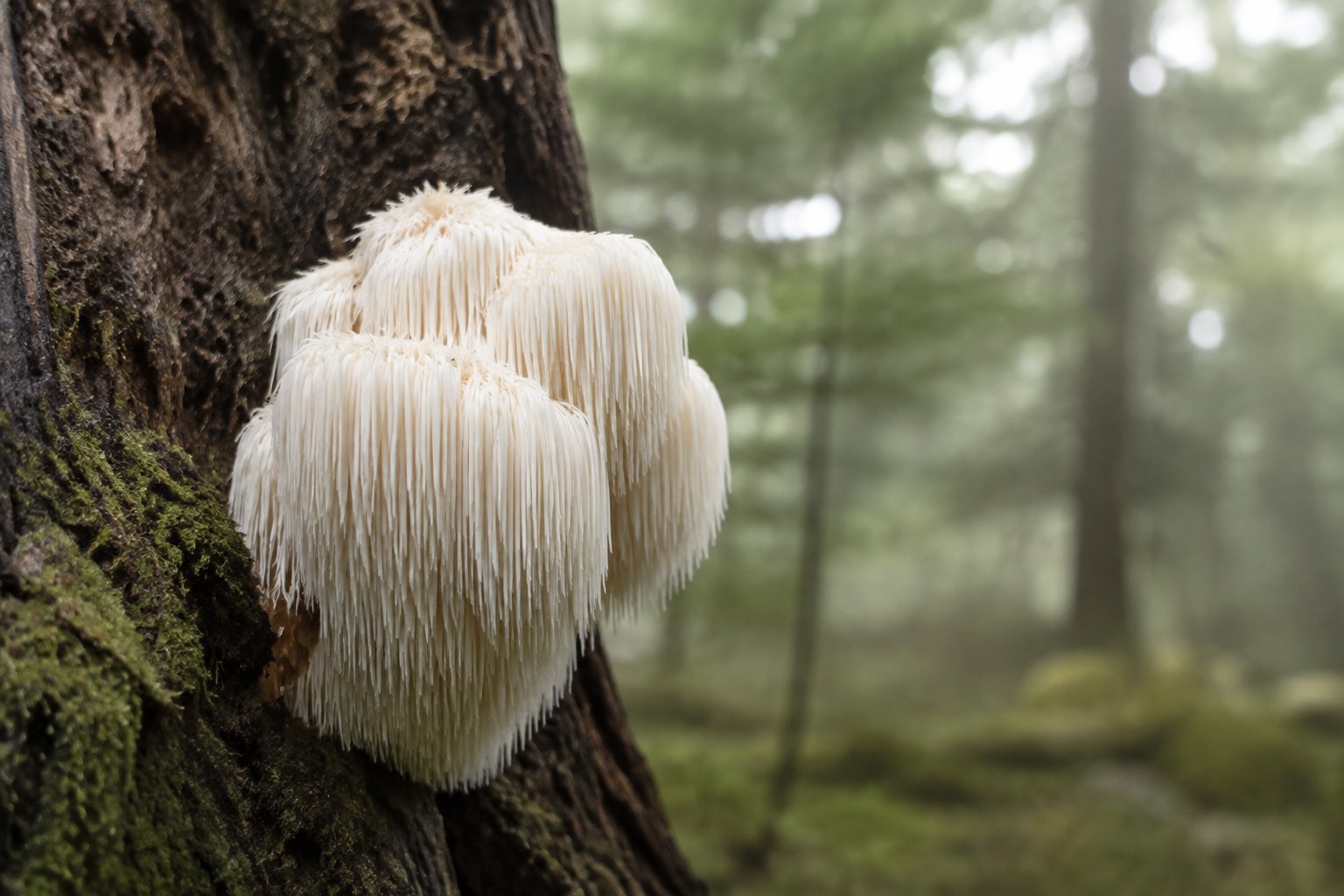
A hardwood specialist
In forests, Lion’s Mane grows on aging, damaged or dead hardwood trees such as beech, oak, maple and birch. The visible white fruiting body emerges from wood, often above the forest floor.
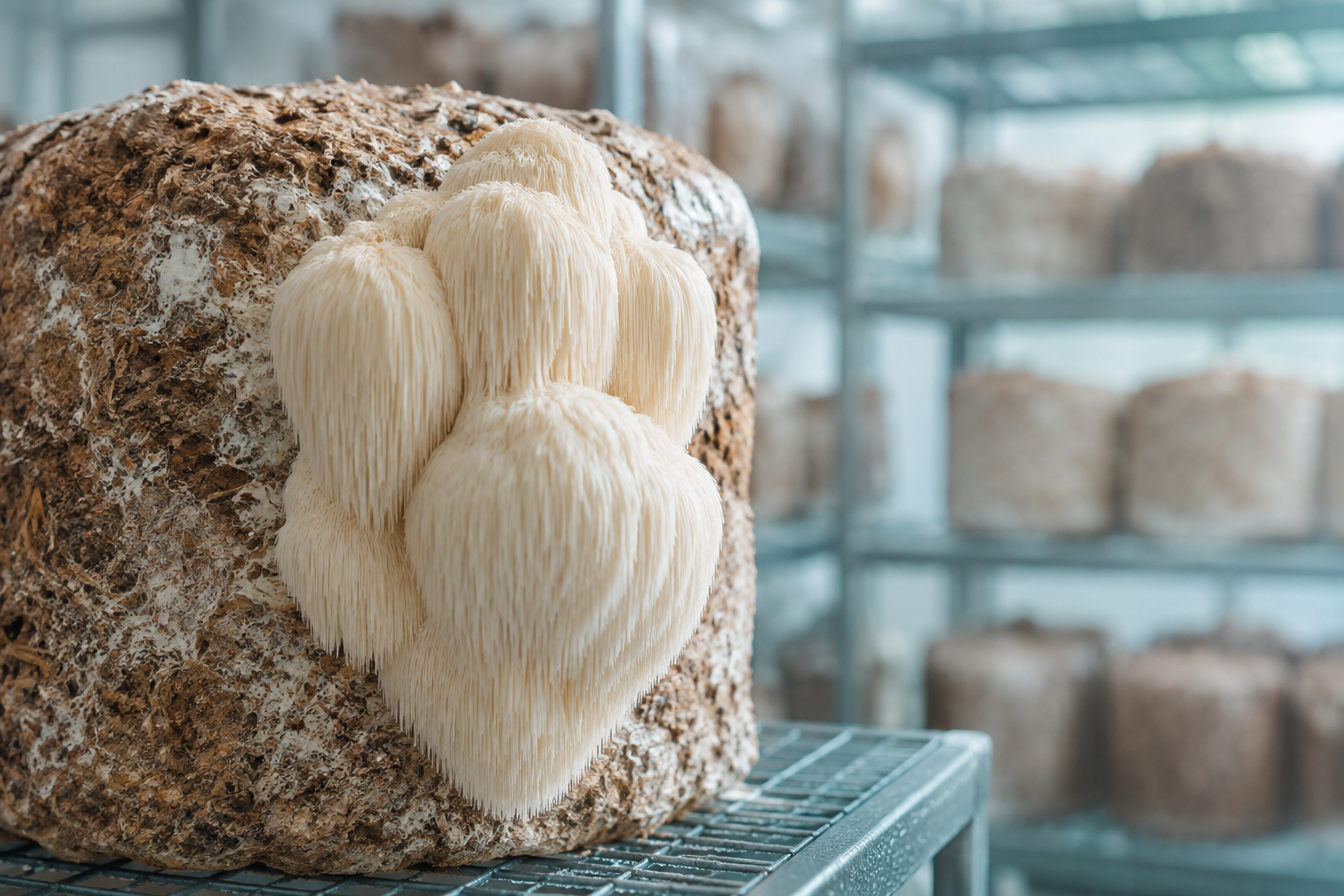
A controlled version of the forest cycle
Growers typically introduce mushroom culture to a prepared, hardwood-rich substrate. The mycelium colonizes that material first, then humidity, airflow and temperature are managed to encourage the familiar cascading fruiting body.
General science sources: Traditional Chinese use and gastrointestinal history · History of mushrooms as food and medicine in Japan · East Asian culinary and traditional use · U.S. Forest Service study of California Indian ethnomycology · Lion’s Mane texture and meat-alternative study · Peer-reviewed Lion’s Mane overview, 2025 · Hericium cultivation study, 2005
General mushroom science
Where can Vitamin D₂ come from?
Think of it as a gift from nature that light can unlock. Mushrooms naturally contain ergosterol, and controlled studies show that ultraviolet light can convert some of it into Vitamin D₂. That creates a mushroom-derived source of Vitamin D that can suit many dietary patterns.
Ergosterol
Think of ergosterol as cholesterol’s fungal cousin: a fat-like building block that helps give mushroom cell membranes structure. When ultraviolet light reaches it, that energy sets off the molecular change that forms Vitamin D₂.
UV exposure
In controlled mushroom studies, ultraviolet exposure triggers a photochemical conversion. Conditions matter, so results vary.
Vitamin D₂
The conversion creates Vitamin D₂, also called ergocalciferol. It is a mushroom-derived form of Vitamin D that can suit many dietary patterns.
General science sources: Journal of Agricultural and Food Chemistry study, 2009 · International Journal for Vitamin and Nutrition Research study, 2017
Vitamin D in daily life
When sunlight changes, Vitamin D still has work to do.
Vitamin D helps the body absorb calcium and maintain strong bones and teeth. It also participates in normal muscle, nerve, immune and cell functions. These are established biological roles, and they continue in every season.
Calcium’s guide
Vitamin D helps the intestine absorb calcium and supports the calcium and phosphate balance needed to mineralize bone.
Bones + teeth
Adequate Vitamin D helps build and maintain bones and teeth. Prolonged deficiency can lead to soft, weak bones.
Beyond bone
Vitamin D is involved in normal neuromuscular and immune function, and Vitamin D receptors are found in many tissues.
Low levels + long-term health
A signal worth reading carefully.
Vitamin D deficiency has established consequences for bone health. Beyond bone, researchers see important patterns, but an observed link is not the same as proof that Vitamin D prevents a disease.
What deficiency is known to do
Prolonged Vitamin D deficiency can cause rickets in children and osteomalacia in adolescents and adults. Both involve bones that do not mineralize normally and can become soft or weak.
Read the NIH deficiency overview ↗What low levels are linked with
Observational studies associate lower blood 25-hydroxyvitamin D with higher all-cause mortality, meaning death from any cause, and with higher cardiovascular disease incidence and mortality. Lower levels have also been studied alongside cancer, depression, type 2 diabetes and multiple sclerosis.
Read the NIH evidence overview ↗What intervention trials show
Large trials have not shown that routine Vitamin D supplementation prevents cancer or cardiovascular disease in generally healthy adults. Mortality reviews are mixed: some find no overall effect and others find a small reduction. These results do not turn a low level into proof of cause.
Age, health, body weight, diet and time outdoors can influence both Vitamin D status and disease risk. This page does not claim that this ingredient prevents or treats disease.
A Canadian year
Turn the seasons. Watch the sunlight change.
The body can make Vitamin D when ultraviolet B light reaches the skin, but latitude and season change how much UVB is available. Choose a season to follow the Canadian sunlight story.
Choose a season
The UVB window narrows.
At Canadian latitudes, very little UVB reaches the surface during much of winter, so skin can make little or no Vitamin D. Statistics Canada reports that the risk of Vitamin D deficiency is more than twice as high during winter.
UVB availability rises gradually.
Longer days can improve the opportunity for skin production, but latitude, cloud cover, time outdoors, clothing, sunscreen, age and skin melanin still influence how much Vitamin D the body makes.
More light does not cancel sun safety.
Canadian sunlight is more favourable for skin production in summer. UV exposure can also damage skin, so Health Canada still recommends sun protection. Food and supplements provide Vitamin D without adding UV exposure.
The sunlight equation starts changing.
As days shorten, the chance to make Vitamin D from sunlight falls. By late October, UVB can be too limited across much of Canada for sufficient skin production, and that low-light period can continue into early March.
Health Canada recommends including Vitamin D from foods or a supplement every day because season and many personal factors can limit skin production.
D₂ and D₃
Same vitamin family. Different starting points.
Both forms are absorbed by the intestine, both raise blood levels of 25-hydroxyvitamin D and both count toward total Vitamin D on Canadian nutrition labels. Open each card to see where the paths differ.
D₂ can begin with mushroom ergosterol.
Ultraviolet light can transform ergosterol found in fungi and yeast into Vitamin D₂. In this Lion’s Mane ingredient, light unlocks the documented D₂ from mushroom chemistry itself.
D₃ begins from a cholesterol relative.
Skin makes Vitamin D₃ when UVB acts on 7-dehydrocholesterol. D₃ occurs naturally in some animal foods, especially fatty fish. Supplemental D₃ is often made from lanolin, and lichen-derived options also exist.
Both D₂ and D₃ can improve Vitamin D status. At equal amounts, research generally finds that D₃ raises blood 25-hydroxyvitamin D higher and maintains it longer than D₂.
General science sources: Health Canada Vitamin D guidance · Statistics Canada seasonal Vitamin D data · NIH Vitamin D functions and D₂/D₃ · VITAL randomized trial · BMJ randomized-trial mortality review · 2023 randomized-trial mortality review · CFIA Vitamin D labelling rules
From our daily ritual
What Team Zentein keeps reaching for.
Our team has been adding this Activated Organic Lion’s Mane Powder to drinks and loving the simple ritual. We wanted to open the ingredient file and share what has earned a place in our own cups.
- Species
- Hericium erinaceus
- Format
- Fine powder
- Material
- Mycelium + primordia + fruiting bodies + extracellular compounds
- Processing
- Gently low-thermal dried + milled
- Vitamin D₂
- 30 µg per 500 mg of dehydrated Lion’s Mane powder · 150% DV
- Certified organic
- Certified organic ingredient
- Grown + processed + packaged
- Canada

Activated Organic Lion’s Mane Powder
A small batch. Ready now.
Our Activated Organic Lion’s Mane Powder is in stock now. Each 50 g pouch provides 100 servings and costs $50.
- Per serving
- 500 mg
- Per bag
- 100 servings
- In the bag
- Scoop included
- Vitamin D
- 150% DVDaily Value per serving
Easy ways to use your powder
- Smoothies
Blend into your favourite fruit or protein smoothie.
- Oats + yogurt
Stir into breakfast or an easy afternoon snack.
- Coffee + cacao
Whisk into coffee, hot cacao or a latte.
- Baking
Mix into batter and portion across your recipe.
- Savoury meals
Stir into soup, chili or stew.
- Sauces + recipes
Mix into pasta sauce, BBQ sauce or your favourite savoury recipes.
Available now. Grown in small batches.
This batch is ready to ship. Lion’s Mane takes time to grow, activate, dry and prepare in batches. Once it sells out, we will accept preorders for the next batch, with about a 4 week wait until restock. We will email you when your preorder is ready, before shipping.
A 50 g bag makes 100 servings of 500 mg. Each serving provides 30 µg vitamin D₂ (150% of the Canadian Daily Value).
Meet the other powder
Superfood Powder $60 CAD
Superfood Powder brings fourteen foods and twelve vitamins together in a 0.5 g serving. Get both powders for $100 CAD, save $10 and choose 2 free Elite Squares. Everything ships together while both powders are available.
What is Superfood Powder?
Fourteen foods in one easy scoop.
Sprouted grains, seeds, fruits, vegetables and mushrooms are dried and milled into one blend. A 0.5 g serving provides twelve vitamins and is basically tasteless when mixed into recipes. Boost your current recipe by stirring it into smoothies, oats, soup, chili or sauces. A 50 g bag contains 100 servings and includes a scoop.
Open the full Superfood ingredient file →A little more to enjoy together
Buy both powders. Save $10. Get 2 free Elite Squares.
Get one 50 g bag of Superfood Powder and one 50 g bag of Activated Organic Lion’s Mane Powder for $100 CAD, instead of $110. Choose 2 free Elite Squares in any mix of flavours.
Choose your 2 free Elite Squares
Both powders are included for $100 CAD. Use + to choose your two free Elite Squares.
 Honey Peanut Crispy
 Salted Double Cacao
 Almondy Raspberry
 Cappuccino Crisp
 Coconut Lime Pie
 PB&J
PB&J
Choose 2 more
Your current-batch bundle ships together.
- 01Ready now · one delivery
Superfood Powder, Activated Organic Lion’s Mane Powder and your 2 free Elite Squares ship together, alongside the other ready-to-ship items in your order.
- 02After either powder sells out
Each powder is prepared in batches. After either powder sells out, there is about a 4 week wait until that powder is back in stock. Order while both are available to receive them together sooner. We will accept preorders for the next batch and email you before your preorder ships.
The Zentein experience
Good food. People who care.
A few favourite five-star store reviews about shopping with Zentein.
“Shopping is easy. Delivery is fast. Customer service has been great!”
“easy and quick responses! questions always answered!”
“Great products. Our customers love the high protein content and great taste.”
Selected store reviews collected through Judge.me (verified customer reviews).
More customer stories →