
Walk down the supplement aisle of any pharmacy, and you'll find rows of brightly coloured bottles promising Vitamin A, Vitamin C, or a multivitamin to “cover all your bases.” It’s easy to feel like you can simplify nutrition by taking a handful of pills each morning.
The challenge is that our bodies don’t typically use nutrients in isolation the way a label lists them. For most of human history, we’ve gotten vitamins and minerals from whole foods: berries, leafy greens, seeds, roots, where nutrients show up together with fibre and many other naturally occurring compounds.
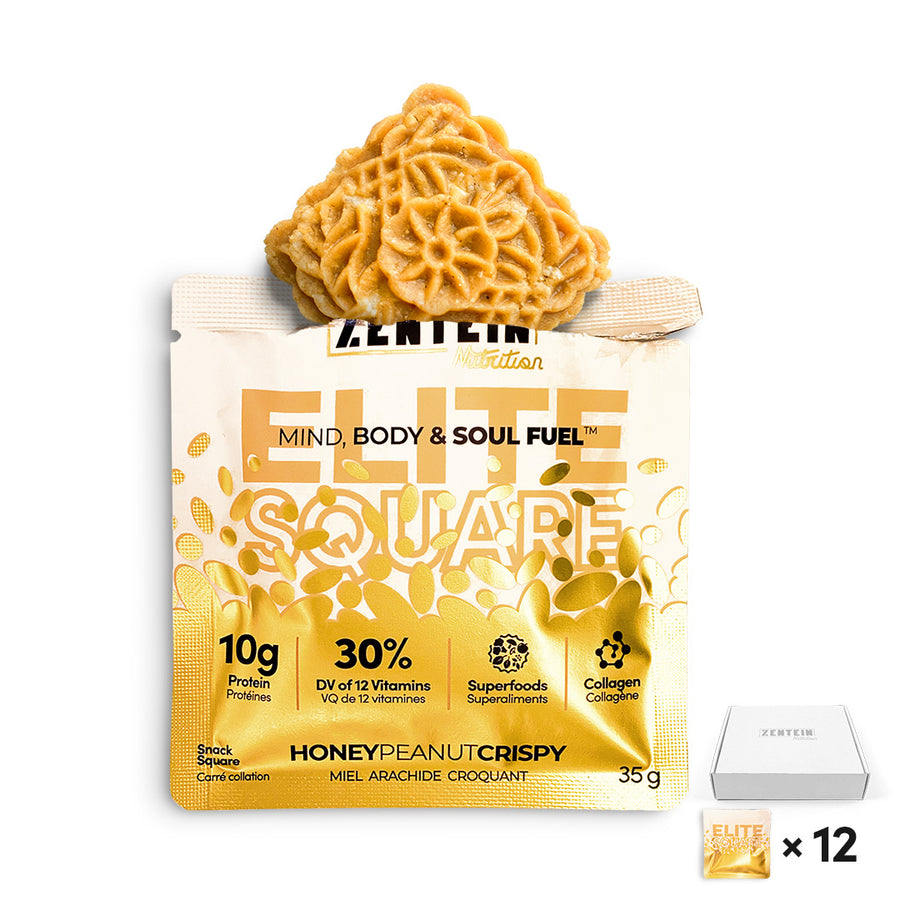
That’s the lens we used when we created Elite Squares: if we can build nutrition with real, whole-food ingredients, why lean on synthetic vitamin fortification as the main strategy?
What's the Difference Between Synthetic and Whole Food Vitamins?
Let's start with the basics.
Synthetic vitamins are nutrients created in a laboratory. They're designed to mimic the chemical structure of vitamins found in nature. You'll find them in most conventional supplements: and in a lot of fortified foods and protein bars, too.
Whole food vitamins come directly from real food sources. They arrive in your body the same way nature intended: surrounded by cofactors, enzymes, fibre, and phytonutrients that help your body recognize and use them.
Think of it like this: a synthetic vitamin is like receiving a single puzzle piece in the mail, while whole-food nutrition is more like receiving the puzzle along with the picture on the box and the pieces that fit around it. In practice, that “context” includes fibre, naturally occurring compounds, and the way foods are structured, all of which can influence how nutrients are absorbed and used.

Why Does Bioavailability Matter?
Bioavailability refers to how much of a nutrient your body can actually absorb and use, and the source of that nutrient can make a real difference.
For example, research comparing natural and synthetic forms of vitamin E has found meaningful differences in how the body handles them, with natural forms often showing higher bioavailability than synthetic versions. In other words, the form and the surrounding “food context” can influence what ends up being available to your cells.
That’s where the idea of a "nutrient matrix" comes in. Whole foods deliver vitamins and minerals alongside other naturally occurring compounds that can support digestion and absorption. When you eat spinach, you’re not only getting iron; you’re also getting fibre and a broad mix of micronutrients that work together as part of a meal.
Synthetic vitamins can still be useful in certain cases, but they’re typically isolated nutrients, and that changes how they behave compared with nutrients delivered through food.
The Problem With Isolated Nutrients
One important nuance is that more isn’t always better when it comes to vitamins, especially when we’re talking about isolated nutrients taken in large doses.
Take vitamin E as an example. Natural vitamin E contains eight different compounds: four tocopherols and four tocotrienols. Each plays a slightly different role in your body. Synthetic vitamin E? It typically contains just one form.
When you focus heavily on a single isolated form of a nutrient, you may shift the balance away from the broader mix that would normally come from food. A simple way to picture it is that you’re relying on one “version” to do a job that, in real diets, is typically shared across multiple forms and interacting nutrients.
This is why we’re careful with products that lean heavily on “fortified with vitamins and minerals” as a headline claim. Fortification can be helpful, but it doesn’t automatically mean the nutrition behaves like nutrition from food, and the details (forms, doses, and the rest of the ingredient list) matter.
At Zentein, we believe in a different approach. One that trusts the wisdom of real food.
Why We Chose 15+ Superfoods for Elite Squares
When we developed Elite Squares, we wanted something that felt genuinely nourishing and straightforward: a convenient snack built around whole-food ingredients rather than relying on a long list of synthetic add-ins.
The goal was real nutrition from real food, in a format that still fits into busy days.
So instead of using synthetic vitamins as the primary “nutrition engine,” we packed each Elite Square with over 15 superfoods. We’re not using the term as a gimmick; we’re talking about nutrient-dense whole foods that have a long history in diets around the world.
Here's why this matters:
1. Complete Nutrient Profiles
Each superfood brings its own complex matrix of vitamins, minerals, antioxidants, and phytonutrients. When you combine 15+ of them, you're creating a rich tapestry of nutrition that no synthetic multivitamin can replicate.
2. Better Absorption
Because these nutrients come from whole food sources, your body recognizes them. The cofactors are already present. The enzymes are ready to go. Your digestive system doesn't have to work overtime figuring out what to do with an isolated chemical compound.
3. No Artificial Shortcuts
We don't use synthetic vitamins, artificial colours, or questionable fillers. What you see is what you get: clean ingredients that you can actually pronounce.
The Honest Truth About Supplements
We’re not here to say that all supplements are bad. For some people - those with specific deficiencies, dietary restrictions, or medical conditions - targeted supplementation can be important and appropriate.
For day-to-day wellness, though, a practical north star is often food first, with supplements used thoughtfully when they’re truly needed.
Your body is well-adapted to extracting nutrients from meals and snacks—an apple, a handful of almonds, or a square made with whole-food ingredients. Supplements can still support certain goals, but they don’t always replicate what happens when nutrients come packaged in food.
And here's the practical side: when you choose whole food sources of nutrition, you're also getting fibre, healthy fats, and protein. You're getting something that actually tastes good and keeps you satisfied. You're eating, not just supplementing.
That's the philosophy behind everything we make at Zentein: from our collagen protein powders to our protein bars. We believe nutrition should come from real ingredients, prepared with care, and designed to nourish you fully.
The Bottom Line
Synthetic vitamins have their place. But they're not a replacement for the complex, beautiful nutrition that whole foods provide.
When we created Elite Squares, we made a deliberate choice: no synthetic shortcuts. Just 15+ superfoods working together the way nature intended.
In the end, most of us benefit from building a strong foundation with real food and using supplements as a tool, not a substitute.
Ready to taste the difference? Explore Elite Squares here and see what whole food nutrition actually looks like.
We wish you the best.
Sources
- Vitamin E - Health Professional Fact Sheet
- https://ods.od.nih.gov/factsheets/VitaminE-HealthProfessional/
- A Randomized Pilot Trial to Evaluate the Bioavailability of Natural versus Synthetic Vitamin B Complexes in Healthy Humans and Their Effects on Homocysteine, Oxidative Stress, and Antioxidant Levels
- https://pmc.ncbi.nlm.nih.gov/articles/PMC6930747/
- Natural vitamins may be superior to synthetic ones
- https://pubmed.ncbi.nlm.nih.gov/11090291/
Keep exploring, or turn the idea into an everyday routine.